
“Relief begins with understanding what your body is telling you.”
Hello, and welcome to ReliefShoulderPainFast.com. My name is Michel Bourgeois, a Licensed Massage Therapist with more than 17 years of experience. Over the years, I have worked with many people experiencing muscular pain associated with fascial restrictions and trigger points. I created this website to share practical information that can help you better understand these problems and learn simple techniques that may help reduce muscular tension and discomfort.
We have all experienced pain at one time or another. Pain is both a
sensory and emotional experience, and it often serves as an important warning
signal, alerting us that something may be wrong and prompting us to respond.
Pain can
take many forms:
Here, you’ll find information about trigger points that may contribute to pain in and around the shoulder. You’ll learn which muscles may be involved, where trigger points are commonly found, how they can produce referred pain, and which self-massage techniques may help relieve muscular tension and discomfort. To get started, select Where Is Your Pain? from the navigation bar. You’ll be taken to a page where you can choose the area in which you feel pain and explore the muscles that may be contributing to it. You can also visit the Blog, where I discuss a variety of health, wellness, and pain-related topics beyond shoulder pain.
Trigger points are sensitive areas within tight bands of muscle, commonly called “muscle knots,” that may cause pain locally or refer pain to another area of the body.
Myofascial pain involves muscles and the connective tissue surrounding them and may contribute to persistent muscular pain, stiffness, and restricted movement.
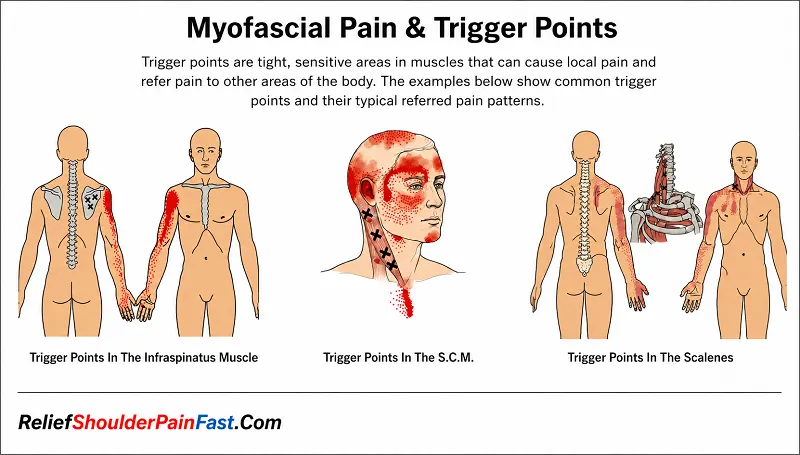
Many of the articles on this site will help you understand where these painful areas may originate and introduce practical self-care techniques for relieving muscular tension.

Discover how a simple tennis ball can help relieve muscle pain and tension.
Learn how a massage cane can help you reach common trigger points and areas of tension.
Learn how to use your hands to help relieve muscle pain and tension.
Explore the shoulder’s anatomy and discover the four muscles that form the rotator cuff.