The Sternalis
The Sternalis Muscle: Trigger Points and Referred Pain
Where Is the Sternalis Located?
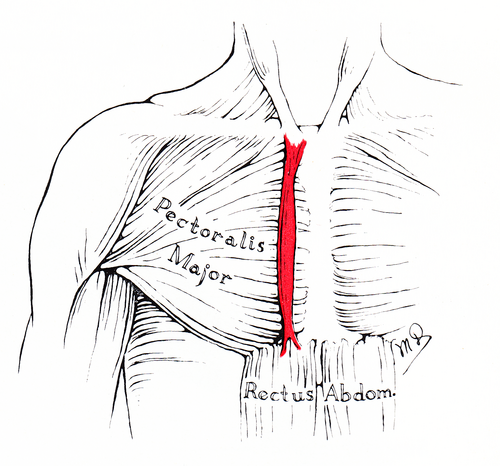
About the Sternalis
The sternalis is an uncommon anatomical variation that is not present in everyone. When present, it is a thin muscle at the front of the chest, running vertically beside or over the breastbone and lying on top of the pectoralis major. Its exact function is uncertain.
Because this muscle is uncommon and its appearance varies considerably, it may easily be overlooked. A tender point in the sternalis may contribute to discomfort over the breastbone or chest wall, but chest pain should never automatically be assumed to come from a muscle.
Sternalis Referred Pain and Related Symptoms
Trigger points associated with the sternalis have been described as producing pain over the breastbone or nearby chest wall. In some people, discomfort may extend toward the front of the shoulder or along the inner upper arm.
- Localized tenderness beside or over the breastbone.
- Aching or tightness across a small area of the chest wall.
- Discomfort that may extend toward the front of the shoulder.
- Referred discomfort that may travel along the inner upper arm.
- Symptoms that may increase with certain upper-body movements.
These symptoms may resemble those associated with the pectoral muscles, ribs, breastbone, or other chest-wall structures. More importantly, chest discomfort may have cardiac, pulmonary, digestive, or other medical causes. A referred-pain pattern cannot confirm that the sternalis is responsible.
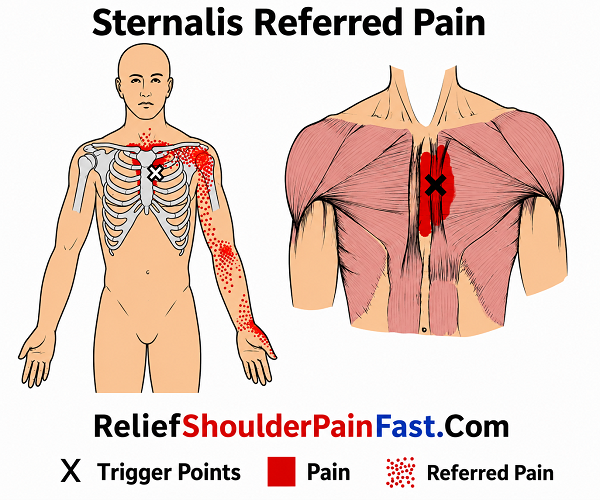
The image above shows possible locations of sternalis trigger points and referred discomfort.
What May Contribute to Sternalis Trigger Points?
- Repeated pushing, pulling, or forceful upper-body activity.
- Strength exercises that heavily load the chest.
- Prolonged rounded-shoulder or forward-chest posture.
- Frequent coughing or other repeated chest-wall strain.
- A direct impact or strain involving the chest wall.
- A sudden increase in upper-body training or manual activity.
How to Help Prevent Sternalis Trigger Points from Returning
- Increase upper-body exercise intensity gradually.
- Take breaks from repetitive pushing or pulling activities.
- Use relaxed, comfortable shoulder positioning while working.
- Warm up before demanding chest or upper-body exercise.
- Modify movements that repeatedly bring back symptoms.
- Allow enough recovery time between demanding activities.
Pay attention to activities or positions that repeatedly bring back your symptoms. Reducing or modifying the aggravating movement may be as important as massaging the tender area.
Sternalis Self-Massage
If a sternalis muscle is present, gentle self-massage may help reduce localized muscular tenderness.
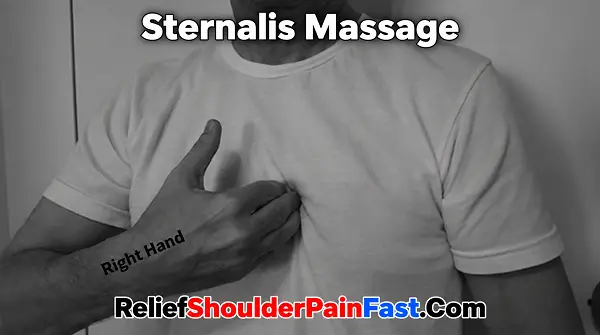
Sternalis Massage Instructions
First make sure that unexplained chest discomfort has been medically evaluated. Using two or three fingertips, gently explore the soft tissue beside the breastbone rather than pressing directly on the bone.
If you locate a small tender area that feels muscular, apply only light, comfortable pressure and use small, slow movements. Keep the session brief and never try to force deeply into the chest wall.
Use caution: Do not massage unexplained chest pain, a lump, swollen tissue, injured ribs, or an area affected by recent surgery. Stop immediately if you experience chest pressure, shortness of breath, sweating, nausea, dizziness, faintness, or pain spreading to the jaw, back, shoulder, or arm.
Sources and References
- Clair Davies and Amber Davies. The Trigger Point Therapy Workbook: Your Self-Treatment Guide for Pain Relief. New Harbinger Publications, 2013.
- Bilateral Sternalis Muscles: The Clinical Significance of an Uncommon Anatomical Variation — National Library of Medicine.
- Sternalis Muscle in Jordanian Population: A Prevalence Study — National Library of Medicine.