The Latissimus Dorsi
The Latissimus Dorsi Muscle: Trigger Points and Referred Pain
Where Is the Latissimus Dorsi Located?
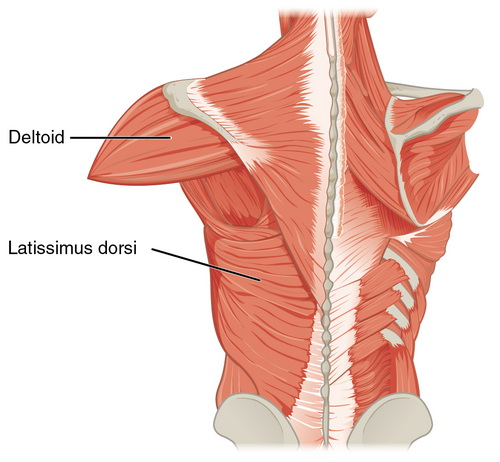
About the Latissimus Dorsi
The Latissimus Dorsi is a large, broad muscle that covers much of the middle and lower back. It begins along the lower spine and pelvis, then narrows as it passes beneath the arm to attach to the upper arm bone.
It helps pull the arm downward and backward and rotate it inward. It works during movements such as pulling, climbing, swimming, rowing, and using crutches.
Latissimus Dorsi Referred Pain and Related Symptoms
Trigger points in the Latissimus Dorsi may refer pain around the lower shoulder blade and the back of the shoulder. Discomfort may also travel down the inner arm toward the hand.
- An ache around the lower part of the shoulder blade.
- Pain at the back of the shoulder.
- Discomfort when reaching upward or forward.
- Pain during pulling, climbing, or rowing movements.
- A feeling of tightness along the side of the back.
These symptoms may resemble other muscular, joint, rib, or nerve-related conditions. A referred-pain pattern may provide a useful clue, but it cannot confirm the cause of shoulder, back, or arm pain.
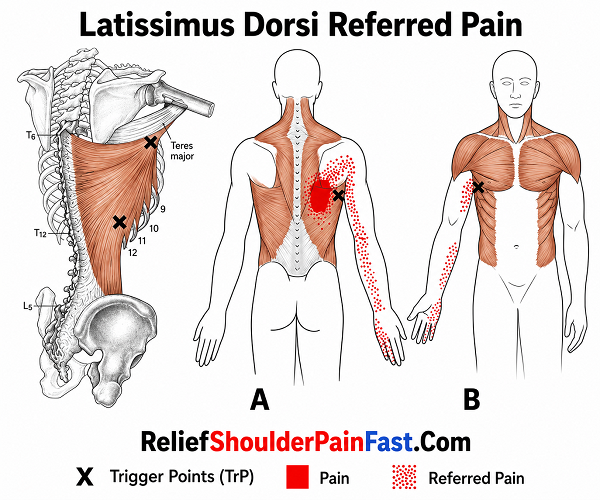
The image above shows possible Latissimus Dorsi trigger points and referred discomfort.
What May Contribute to Latissimus Dorsi Trigger Points?
- Repeated pulling, rowing, swimming, or climbing.
- Heavy lifting with the arms extended.
- Forceful throwing or frequent overhead activity.
- Using crutches for an extended period.
- Suddenly catching or pulling a heavy object.
- Working for long periods with the arms raised.
How to Help Prevent Latissimus Dorsi Trigger Points from Returning
- Reduce or modify pulling and overhead movements that aggravate the area.
- Increase swimming, rowing, climbing, and strength exercises gradually.
- Take regular breaks during repetitive upper-body work.
- Keep heavy objects close to your body while lifting.
- Warm up before demanding upper-body activity.
- Allow enough recovery time between strenuous activities.
Reducing or modifying the aggravating movement may be as important as massaging the tender area.
Latissimus Dorsi Self-Massage
Gentle self-massage may help reduce tension and tenderness in the Latissimus Dorsi.
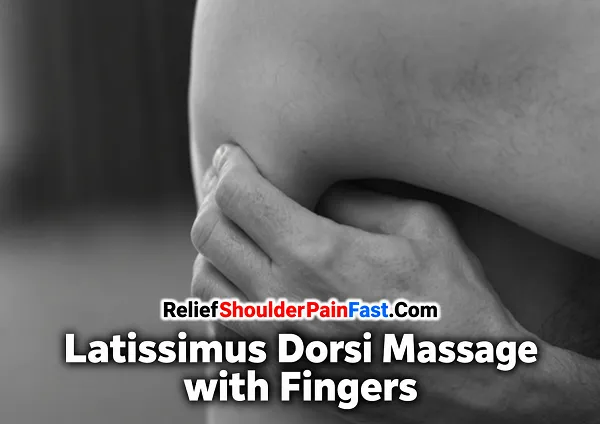
1. Massage With Your Fingers
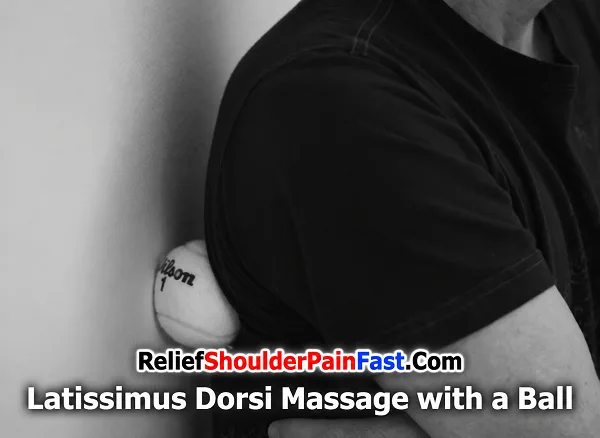
2. Massage With a Tennis Ball
Latissimus Dorsi Massage Instructions
Picture 1 — Massage with Your Fingers: To massage your right latissimus dorsi, reach across with your left hand and gently grasp the muscular tissue along the lower part of the back wall of your armpit. Hold the tissue between your thumb, index finger, and middle finger, then massage it slowly using a comfortable pressure or make small, slow movements from side to side and up and down. The latissimus dorsi and the subscapularis muscle are close together in this area, so this technique may allow you to massage both muscles at the same time. Avoid pinching deeply inside the armpit.
Picture 2 — Massage with a Tennis Ball: Place a tennis ball between a wall and the muscular area along the side of your back. Lean into it gently and move slowly until you locate a tender area. Hold comfortable pressure briefly, then release.
Use caution: Do not press directly inside the armpit or roll forcefully over the ribs or spine. Stop if the massage causes sharp pain, increasing weakness, numbness, or tingling.
Sources and References
- Clair Davies and Amber Davies. The Trigger Point Therapy Workbook: Your Self-Treatment Guide for Pain Relief. New Harbinger Publications, 2013.
- Back Muscles: Anatomy and Function — Cleveland Clinic.
- Anatomy, Back, Latissimus Dorsi — NCBI Bookshelf.
I hope you find this information helpful.
Thank you for reading,
Michel Bourgeois
Licensed Massage Therapist
This article is provided for educational purposes only and does not constitute medical advice, a diagnosis, or a treatment.