What is sound healing?
Sound healing is a wellness practice that uses sounds and vibrations to encourage relaxation. Some people find these sessions calming and feel that they help release physical or emotional tension.
Which instruments are used in sound healing?
Various instruments can produce sounds and vibrations:
- Tibetan singing bowls
- Crystal singing bowls
- Gongs
- Drums
- Tuning forks
- Koshi chimes
- Tongue drums
- Native American flutes
- Rainsticks
- Cymbals
There are many more instruments, but this article focuses on tuning forks.
Types of tuning forks
There are two main types of tuning forks: weighted and unweighted. Weighted tuning forks have weights at the ends of their prongs and produce a vibration that is easier to feel when they are placed gently on the body. Unweighted tuning forks produce a clearer sound and are generally used at some distance from the body for meditation or relaxation.
In some energy-based approaches, weighted tuning forks are placed on specific points of the body or along paths traditionally associated with meridians. These concepts belong to complementary practices and should not be presented as medically proven mechanisms.
I personally use the 128 Hz Otto tuning fork from BioSonic Enterprises and the 136.1 Hz Mid Ohm tuning fork, sometimes called the “Earth frequency,” from Sound Healing Tools.
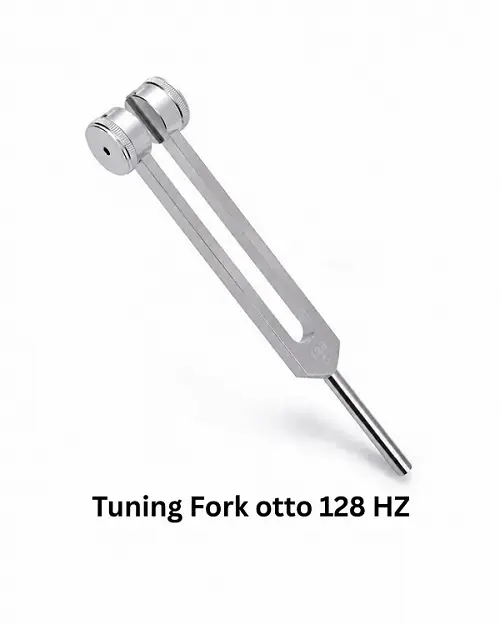
Why did I choose these two tuning forks?
I first used the 136.1 Hz fork, then I bought the 128 Hz Otto tuning fork when I was working at two different locations. I chose them because their low, sustained vibrations fit the way I incorporate relaxation into a session.
People who use these tuning forks sometimes report feeling relaxed, slowing down internally, or becoming more aware of their bodies. These experiences are subjective and do not guarantee any particular therapeutic effect.
Possible wellness goals
- Encourage relaxation
- Create a moment of calm
- Encourage slower breathing
- Improve body awareness
Claims to avoid
- Treat depression or anxiety
- Strengthen the immune system
- Directly reduce inflammation
- Cure an illness or neurological disorder
What is nitric oxide?
Nitric oxide is a molecule produced naturally by the body. Among other things, it helps dilate blood vessels and regulate circulation. However, it has not been established that a session using 128 Hz or 136.1 Hz tuning forks increases nitric oxide production to a clinically meaningful degree or directly lowers cortisol levels. It is therefore best to describe tuning forks as a relaxation practice rather than a physiological treatment.
Precautions for weighted tuning forks
Before using a tuning fork directly on the body, check the manufacturer’s guidance and consult a healthcare professional if the person has a medical condition. Avoid applying a tuning fork to an area that is painful, injured, or has reduced sensation.
- Do not place a tuning fork over a pacemaker, defibrillator, insulin pump, or another implanted medical device.
- Seek medical advice in cases of pregnancy, significant osteoporosis, active cancer, recent surgery, a fracture, or a recent concussion.
- Do not apply a tuning fork directly over varicose veins, wounds, cuts, burns, rashes, or swollen areas.
- Never apply a painful vibration or firm pressure to the front or side of the neck.
What is the vagus nerve?
The vagus nerve, also called the tenth cranial nerve or cranial nerve X, runs along both sides of the body and is an important part of the autonomic nervous system. It connects the brain to several structures in the neck, chest, and abdomen.
It helps regulate many involuntary functions, including heart rate, breathing, and digestion. It plays a major role in the parasympathetic nervous system, often associated with “rest and digest,” in contrast to the sympathetic nervous system’s “fight or flight” response.
My personal tuning fork relaxation routine
Have the person lie comfortably on their back. Place one hand behind the head near the external occipital protuberance and the other hand on the forehead. Invite them to take three slow, comfortable breaths, then remove your hands.
Gently touch the skin with your fingertips at the points shown in the diagram. Use very light pressure, similar to touching an eyelid, for about 20 to 30 seconds. These contacts come from a traditional energy kinesiology approach and are not medical points that can treat an organ.
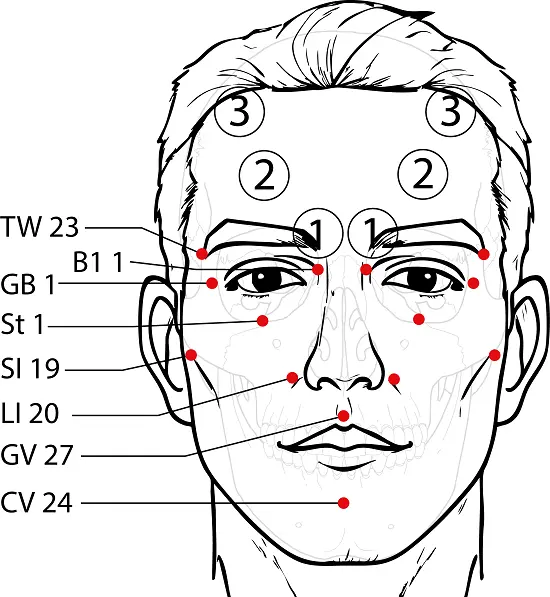
The three areas shown are the glabella, the frontal eminences, and the hairline. Contact should always be gentle and comfortable.
The neck and the anatomical path of the vagus nerve
The vagus nerve runs deep in the neck, close to important structures such as the carotid artery and jugular vein. It cannot be isolated or massaged directly through the skin. For safety, avoid deep pressure or strong vibration on the front or side of the neck.
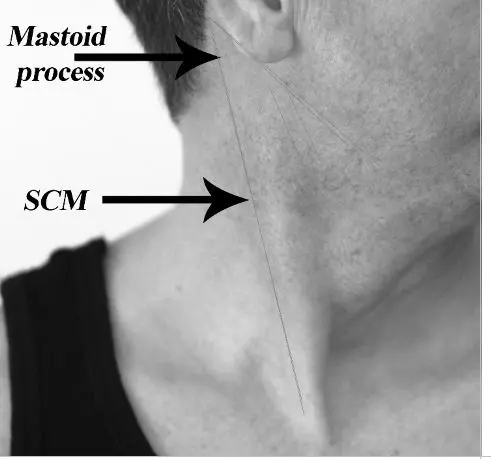
Mastoid process and sternocleidomastoid muscle
The mastoid process is a bony projection at the base of the skull, behind and below the outer ear. If you use a tuning fork in this area for relaxation, place it gently on the bone, away from the soft tissues at the front or side of the neck.
Avoid pressure over the carotid area. If you feel a pulse, immediately remove the tuning fork or your fingers.
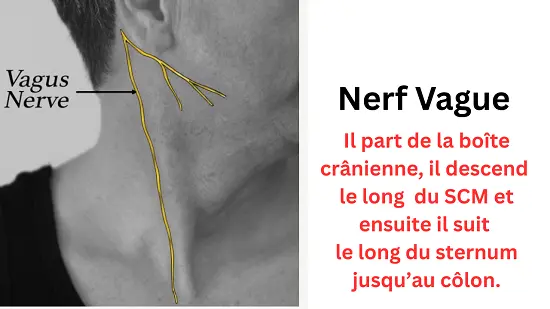
The diagram shows the general path of the vagus nerve from the skull toward the chest and abdomen. A vibration applied to the breastbone or abdomen may feel relaxing, but it does not mean the entire vagus nerve has been directly stimulated.
I hope you find this information helpful.
Thank you for reading,
Michel Bourgeois
Licensed Massage Therapist