
What Is Energy Kinesiology?
Energy Kinesiology is a complementary practice that combines the art of muscle testing with the TCM (Traditional Chinese Medicine) and Western Medicine.Because Kinesiology incorporates the Chinese Medicine models of the Meridians system and the 5 Elements, it recognizes the flows of energy within the body not only relate to the muscles but to every organ that make the human body.
My training in Energy Kinesiology taught me to take a whole-person approach that considers four aspects of well-being: structural (including physical pain), emotional, biochemical (including nutrition), and energetic (including the flow of chi).
The word kinesiology also means the scientific study of human movement. Energy Kinesiology is a distinct complementary approach; the terms should not be treated as interchangeable. [1]
Where Does the Approach Come From?
Energy Kinesiology developed from approaches influenced by applied kinesiology, introduced by chiropractor George Goodheart in the 1960s. Touch for Health emerged in the 1970s and helped bring muscle-monitoring methods beyond chiropractic settings. Different schools subsequently developed their own techniques. [1]
The practice blends ideas about muscles and movement with concepts drawn from traditional Chinese medicine, particularly meridians and the Five Elements. Some schools also incorporate chakras and the aura. These traditions provide a vocabulary through which practitioners describe balance and wellbeing.
How Does Muscle Monitoring Work in a Session?
The practitioner explains a position and asks the person to hold an arm or leg while gentle pressure is applied in a particular direction. The aim is to observe the response, rather than ask the person to exert maximum strength. Any position should be adapted to the person’s comfort and movement limitations.
Practitioners may repeat the movement while discussing a concern or introducing a technique. Within their framework, a change in resistance is interpreted as an indicator of stress or an energetic imbalance. “Biofeedback” is sometimes used informally to describe this process; it refers here to the practitioner’s interpretation of the muscle response.
A session is a collaborative process: you can ask what is being done, describe what you feel, and decline any movement that is uncomfortable.
Meridians, Muscles, and the Small Intestine
In traditional Chinese medicine, meridians are described as pathways through which Qi, or vital energy, flows. Energy Kinesiology systems associate particular muscle tests with particular meridians and organ names.
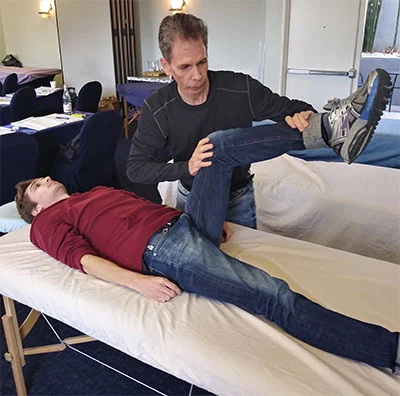
In the photograph above, I am demonstrating a test that my training associates with the small-intestine meridian. In this context, “small intestine” names an energetic association within the system. The photograph shows a muscle-monitoring technique, rather than a measurement of digestion or intestinal function.
The Five Elements—Wood, Fire, Earth, Metal, and Water—provide another traditional way of organizing these relationships. Practitioners use these associations to guide their choice of balancing techniques.
Four Areas Considered in My Training
The following categories summarize the framework I learned. They describe how the practice organizes a session:
Energetic / “Electrical”
Meridian tracing, acupressure points, and concepts such as chakras, the aura, and under- or over-energy. “Electrical” is a traditional label used in some training systems, rather than a clinical measurement of electrical activity.
Emotional
Thoughts, beliefs, emotions, and the stresses of daily life. A session may include conversation, breathing, or gentle exercises intended to support relaxation and personal awareness.
Structural
Posture, movement, and muscular tension. Depending on the practitioner’s qualifications, this may include gentle movement or hands-on work directed at comfort.
Biochemical
Food, nutrition, and environmental influences are topics included in some training systems. Questions about diet, supplements, or suspected deficiencies need to be considered within the practitioner’s professional scope.
Why Do People Seek Energy Kinesiology?
People may be interested in the practice during stressful periods, life changes, or when exploring complementary approaches to wellbeing. Others are curious about the connection between emotions, physical tension, and the way they feel day to day.
Practitioners may use gentle touch, acupressure, meridian tracing, breathing, or movement exercises with the intention of encouraging relaxation and a sense of balance. The choice of techniques varies with the school of training and the person’s preferences.
Scientific Evidence and the Limits of Muscle Testing
Energy Kinesiology’s proposed energy pathways and its use of muscle responses to identify hidden causes or subconscious information are not established medical diagnostic methods. Ordinary clinical muscle testing evaluates strength and function; that does not validate using a muscle response to assess organ health, read the subconscious, or identify an energy blockage.
The Australian Government’s 2024 evidence evaluation found one eligible trial involving 70 people with chronic low-back pain. Its findings were too uncertain to establish benefit, and the review found no eligible studies for the other health conditions it examined. [1]
Muscle testing should not be used to diagnose food allergies or sensitivities, nutritional deficiencies, or heavy-metal toxicity, or to decide which supplements or doses you need. The American Academy of Allergy, Asthma & Immunology advises against applied kinesiology for allergy testing. [2]
Energy Kinesiology is a complementary option, not a substitute for medical assessment or treatment. Feeling relaxed after a session does not confirm an energetic explanation. Persistent or new symptoms deserve appropriate medical evaluation; keep decisions about medication, dietary restrictions, and treatment with your qualified healthcare professional.
My Perspective as a Practitioner
I am a Licensed Massage Therapist, certified in Energy Kinesiology and Biochemical Kinesiology. These studies have added another perspective to my interest in muscular tension and whole-person wellbeing.
For me, explaining an approach clearly is part of respecting the person receiving it. My goal is to give you a useful introduction to what Energy Kinesiology involves, the language practitioners use, and the boundaries that matter when considering a session.
Sources and Further Reading
- Australian Government: Natural Therapies Review 2024—Kinesiology Evidence Evaluation. Includes background, terminology, and the systematic review’s findings.
- American Academy of Allergy, Asthma & Immunology: Allergy Testing.
- Better Health Channel: Kinesiology. General overview of the complementary practice.
I hope you found this information useful. Thank you for reading!
Michel Bourgeois, Licensed Massage Therapist
Certified in Energy Kinesiology and Biochemical Kinesiology