The Deltoid: Trigger Points and Referred Pain.
Where Are the Three Portions of the Deltoid Located?
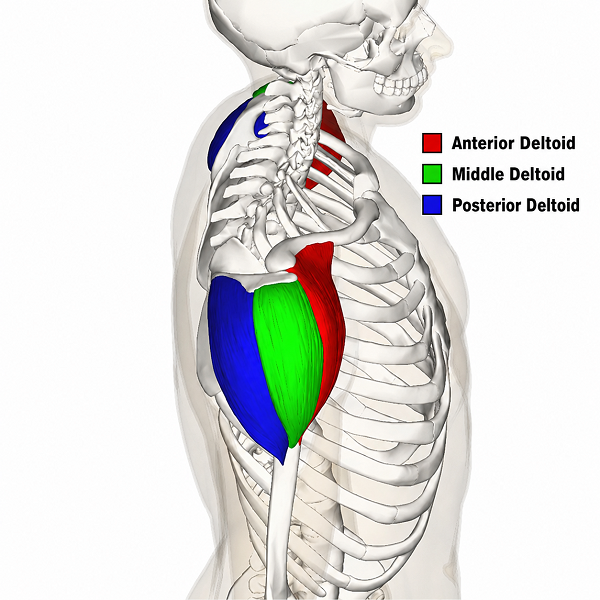
Anatomography (en:Anatomography (setting page of this image)) [CC BY-SA 2.1 jp], via Wikimedia Commons
About the Three Portions of the Deltoid
The deltoid is a large, triangular muscle that covers the shoulder joint. Although it is
one muscle, it has three distinct portions: the anterior deltoid, middle deltoid, and
posterior deltoid. Each portion helps move the arm in a different direction
and may produce a slightly different referred-pain pattern when trigger points develop.
Anatomically, the anterior portion primarily assists flexion and internal rotation,
the middle portion primarily abducts the arm, and the posterior portion assists extension
and external rotation.
| Portion | Location | Primary Movements |
|---|---|---|
| Anterior Deltoid | Front of the shoulder | Raises the arm forward and assists with internal rotation |
| Middle Deltoid | Side of the shoulder | Raises the arm out to the side |
| Posterior Deltoid | Back of the shoulder | Moves the arm backward and assists with external rotation |
Deltoid Trigger Points: Common Symptoms
- Localized pain in the front, side, or back of the shoulder.
- Tenderness when pressing the affected portion of the deltoid.
- Pain when raising or moving the arm
- Reduced or uncomfortable shoulder movement.
- A feeling of weakness or fatigue during shoulder activity.
Referred pain from deltoid trigger points may resemble symptoms associated with other shoulder conditions, including:
- Deep pain in the shoulder joint.
- Pain in the front or back of the shoulder
- Pain along the inner border of the shoulder blade
- Reduced shoulder mobility
- Discomfort when reaching behind the back
About the Anterior Deltoid
The anterior deltoid forms the front portion of the shoulder. It helps lift the arm forward and assists with inward rotation. Trigger points in this portion generally produce pain concentrated over the front of the shoulder.
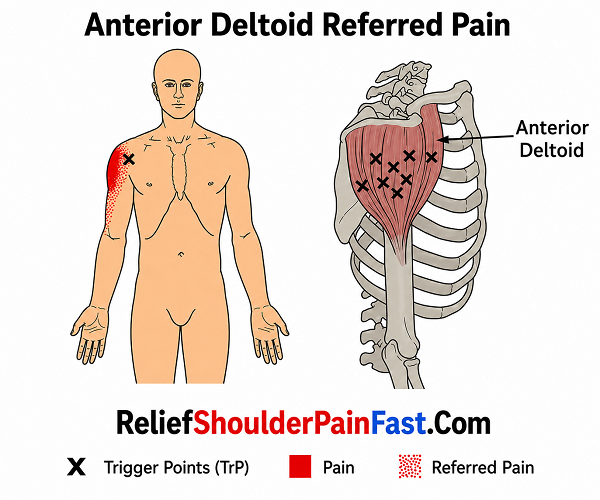
The image above shows possible locations of Anterior Deltoid trigger points.
About the Middle Deltoid
The middle deltoid forms the rounded outer portion of the shoulder and is primarily responsible for lifting the arm out to the side. Because it is the largest of the three heads and works strongly during many arm movements, it may be particularly susceptible to overuse. Its referred pain is generally concentrated over the outer shoulder.
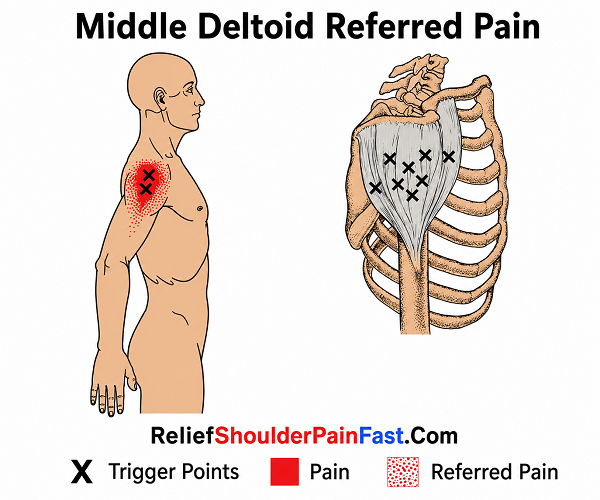
The image above shows possible locations of middle deltoid trigger points.
About the Posterior Deltoid
The posterior deltoid forms the back portion of the shoulder. It helps move the arm backward and assists with outward rotation. Trigger points in this portion generally produce pain over the back of the shoulder.
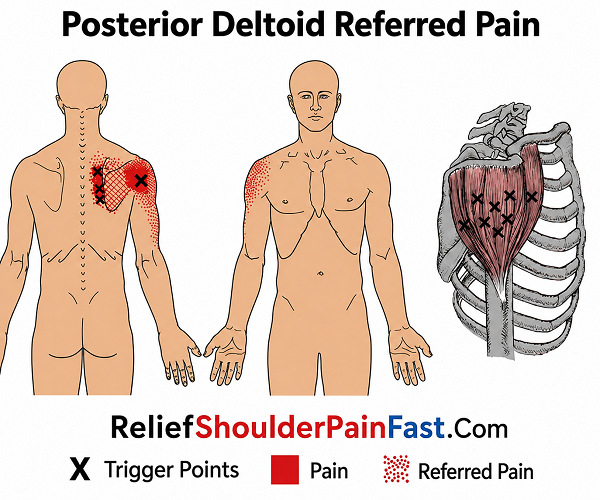
The image above shows possible locations of middle deltoid trigger points.
How to deactivate the Deltoid trigger points

Anterior Deltoid
Trigger points Deactivation with a supported thumb to avoid hurting the thumb

Middle Deltoid
Middle Deltoid massage with a tennis ball, that will Deactivate the trigger points

Posterior Deltoid
Posterior Deltoid massage with a tennis ball, that will Deactivate the trigger points
Trigger points Deactivation
When using a tennis ball to massage the middle and posterior deltoid, you can either hold steady pressure on a tender area or make small, slow movements from side to side and up and down. Keep the pressure comfortable and avoid rolling directly over the shoulder joint or bone.
Tenderness may indicate a sensitive area, but it does not necessarily confirm the presence of a trigger point. Several short sessions may be more comfortable than one prolonged session.
Sources and References
- Clair Davis & Amber Davis. The Trigger Point Therapy Workbook: Your Self-Treatment Guide for Pain Relief..New Harbinger Self-Help Workbook,2013.
- The Deltoid: Anatomy and Function — TeachMeAnatomy.Com
- Anatomy, Shoulder and Upper Limb, Deltoid Muscle — NIH
I hope you find this information helpful.
Thank you for reading,
Michel Bourgeois
Licensed Massage Therapist
This article is provided for educational purposes only and does not constitute medical advice, a diagnosis, or a treatment.